Viking · Troubleshooting
Viking Refrigerator Not Cooling
On a Viking built-in the refrigerator gets its cold air from the freezer coil, so a warm refrigerator beside a cold freezer usually means a fan, frost or a sensor, not the compressor. When both sections are warm, look higher up: the condenser, its fan, the compressor drive or the sealed system.
$79 service call, applied to the repair. Monday to Saturday, 8 AM to 7 PM.
In short: wake the panel and check the bars, look for the showroom light, and clean the condenser behind the top grille with the power off. Then measure: a glass of water on the middle shelf should read 38 to 40°F after five to eight hours, and the freezer 0 to 2°F. Move perishables to a cooler as soon as the refrigerator reads above 40°F, and throw out any that sat above 40°F for two hours or more.
First, the checks you can do in a few minutes
You need a flashlight, a soft brush and a thermometer. The panel steps are for the Viking 5 Series built-ins (models like VCSB542, DDSB548 or DFBB536); other Viking refrigerators have different controls, but the thermometer, door and condenser checks still apply. None of this puts you near wiring or refrigerant.
- Read the settings. Press ACTIVATE CONTROLS, then REF TEMP or FRZ TEMP. One bar is the warmest and nine the coldest; the factory leaves both at five. A setting bumped to one or two bars while wiping the panel is a common, harmless cause.
- Rule out showroom mode. A blue light two places to the right of HIGH TEMP means the panel works but the compressor and fans are held off. To leave it, keep ACTIVATE CONTROLS pressed, add HIGHER and ALARM OFF, and hold all three until the third beep.
- Check the power. Every temperature bar flashing means the power was off at some point. Press ALARM OFF and make sure the rocker switch behind the center grille louver was not left off after cleaning.
- Measure instead of guessing. For the freezer, press the thermometer between frozen packages. Change a setting one bar at a time and measure again after the same wait.
- Look at the condenser. With the breaker or the rocker switch off, shine a light through the top grille. If the fins are matted with dust, brush and vacuum what you can reach without bending them.
- Listen. With the power back on and the doors closed, the condenser fan up top should run with the compressor, and air should move softly at the top of the refrigerator.
- Check the doors and the air path. The door alarm sounds after about three minutes open. Look for a folded gasket, and keep tall items away from the fan cover at the top of the refrigerator and the freezer's back vents.
Read the pattern
Because one coil cools both sections, which side is warm tells us a lot before any tools come out.
| What you notice | What it usually points to | Next step |
|---|---|---|
| Refrigerator warm, freezer still cold | Refrigerator fan, frost blocking the air from the freezer coil, or the refrigerator sensor | Listen for the fan and look for frost on the freezer back wall, then call. |
| Both sections warm, top running constantly | Dirty condenser or a failing condenser fan | Clean the coil with the power off; if it stays warm, call. |
| Both sections warm, little sound from the top | Condenser fan, the compressor relay or the compressor drive (inverter) | Call; these need testing on the visit. |
| Freezer soft, frost on its back wall | Defrost failure or the freezer fan | Do not chip the ice. Call. |
| Cools well after a power cut, then fades again over days | Defrost not running, so frost rebuilds | Note the timing and call. |
| Panel works normally, nothing running | Showroom mode, or a control board | Check for the blue showroom light first. |
| Bars 4 to 7 lighting in turn, with a tone | A temperature sensor circuit has opened | Press ALARM OFF and call. |
More on these displays in Viking refrigerator error codes.
What it usually turns out to be
Dirty condenser or a stopped condenser fan
What it usually is: the coil on top pulls kitchen air through the grille. Once the fins clog, the compressor cannot shed heat, runs long and hot, and both sections slowly warm. A seized condenser fan does the same within hours.
What you can check: the coil, with the power off, and whether the fan spins when the compressor runs.
What we do: clean the coil, test the fan and its relay, and check how fast the cabinet pulls down.
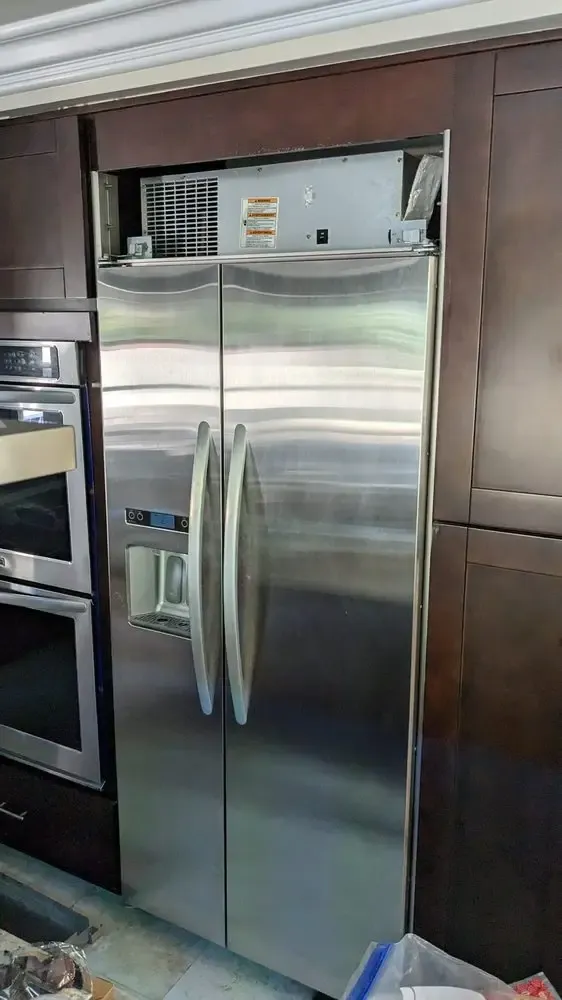
Refrigerator fan, or the air path from the freezer
What it usually is: the refrigerator has no coil of its own. A small fan brings cold air over from the freezer when the refrigerator sensor asks. If that fan fails, or frost or packed food blocks the passage, the freezer stays fine and the refrigerator climbs into the 40s and 50s.
What you can check: air movement at the top of the refrigerator with the door almost closed, and nothing pressed against the fan cover.
What we do: test the fan and the signal to it, and clear any ice in the passage.
Freezer fan
What it usually is: the fan behind the freezer back wall moves all the air across the coil. When it stops, the coil frosts solid and both sections warm, the refrigerator often first.
What you can check: listen at the freezer with the door shut; a squeal before it went quiet suggests a worn motor.
What we do: replace the motor and confirm the coil is clear of ice.
Defrost that stopped working
What it usually is: a heater melts the frost on a schedule the control sets, and a switch on the coil ends the cycle. A burned-out heater, a stuck coil switch or a failed defrost relay lets frost build until air cannot pass.
What you can check: white frost covering the freezer back wall.
What we do: find which part failed, replace it, clear the coil and confirm the next defrost cycle runs.
Temperature sensor
What it usually is: an open sensor or broken wire in either section can stop cooling and usually sets off the scrolling-bar alarm; a shorted freezer sensor keeps the compressor running nonstop.
What you can check: whether bars 4 to 7 are lighting in turn.
What we do: read both sensors against a reference thermometer and replace the one that is off.
Control boards or the compressor drive
What it usually is: the compressor runs through an inverter board on top, which takes a speed signal from the control. A relay that no longer closes, a lost signal or a failed inverter stops a healthy compressor. The drive board has its own fault light, which we read on the visit to tell a lost signal, a failed drive and a failed compressor apart.
What you can check: nothing; the boards sit under the top panels, next to live wiring.
What we do: test the drive and the boards first, so a failed drive is not mistaken for a failed compressor.
Sealed system: leak, restriction or compressor
What it usually is: a refrigerant leak, a blockage or a worn compressor: the least common cause, and the one that most changes the decision.
What you can check: nothing safely.
What we do: rule out the condenser, the fans and the drive, then confirm with pressures and temperatures, quote in writing, and do the work in-house. Our write-up GE Monogram Refrigerator Not Cooling? Refrigerant Leak (a police department in Orange County, March 2025) shows what that involves. See sealed-system repair.
Protect the food and the unit. Once the refrigerator reads above 40°F, move perishables to a cooler with ice. Throw out perishable food that has been above 40°F for two hours or more. Turn the power off before you reach behind the grille, and never cut or open refrigerant tubing.
What a cooling repair costs
A fan, sensor or defrost part sits low in this table and a sealed-system repair at the top; the $79 visit is applied once you approve the written price. Typical built-in refrigerator repair ranges:
Built-in refrigerator and freezer repair (Sub-Zero, Thermador, Viking, Monogram, Miele)
| Repair | Typical price, parts and labor |
|---|---|
| Condenser cleaning and performance check | $150 to $250 |
| Condenser fan motor | $350 to $600 |
| Evaporator fan motor | $350 to $650 |
| Temperature sensor (thermistor) | $250 to $450 |
| Defrost heater or defrost termination | $350 to $650 |
| Water valve | $300 to $550 |
| Door gasket, per door | $300 to $600 |
| Door hinge or closer cam | $300 to $650 |
| Ice maker assembly | $450 to $900 |
| Electronic control board | $650 to $1,300 |
| Refrigerant leak repair and recharge | $900 to $2,000 |
| Evaporator replacement | $1,200 to $2,500 |
| Compressor replacement (sealed system) | from $2,000 |
Typical Orange County ranges for parts and labor. The $79 service call is applied to any of them. Parts that ship from the manufacturer and older or discontinued models can run higher. You get the exact written price after the diagnosis and before any work starts.
How these units are built is on Viking refrigerator repair, a yearly coil cleaning is under refrigerator maintenance, and full rates are on the pricing page. If the ice stopped too, see Viking ice maker not working; other appliances are on Viking repair.
Talk to the technician first
Monday to Saturday, 8 AM to 7 PM. The $79 service call is applied to the repair.
Viking refrigerator not cooling: questions
Why is my Viking freezer cold but the refrigerator warm?
The refrigerator has no coil of its own and gets its cold air from the freezer through a fan. A failed fan, frost blocking the passage or a bad refrigerator sensor gives exactly this pattern.
Why are all the temperature lights on my Viking panel flashing?
That is the power-up alarm. The unit lost power at some point, from an outage, the breaker or the switch behind the grille. Press ALARM OFF; if it also feels warm, measure and call.
My Viking runs almost all the time. Is that a fault?
Not by itself; the variable-speed compressor is meant to run long at low speed. Nonstop running with both sections warming points to a dirty condenser, a failing condenser fan or a faulty freezer sensor.
How long does a Viking built-in take to cool down?
After a power-up or a repair, give it up to 24 hours to settle at its setting. MAX REF and MAX FRZ run a section at its coldest for four hours if you need a faster pull-down.
Should I unplug my Viking to reset it?
Once is fine if the panel is frozen. The control holds the compressor off for several minutes after each restart, repeated restarts do not fix a cooling fault, and a defrost fault can look cured for a day.
How warm is too warm for a Viking refrigerator?
A glass of water on the middle shelf above 40°F, or a freezer that will not hold near 0°F after a day at its setting, means it needs attention.
Can a dirty condenser alone make my Viking warm?
Yes, and it is the first thing we look at when both sections are warm. A careful brushing and vacuuming with the power off often brings the temperatures back within a day.