Wine storage · Orange County
Wine Refrigerator and Wine Storage Repair
A wine refrigerator is a small, gentle refrigeration system asked to hold one temperature very steadily, often in two zones and often behind a custom panel. When it drifts, the cause is usually air flow, a zone fan, a sensor, the door seal or the valve that shares the cold between zones, and most repairs are done in place with the bottles inside.
$79 service call, applied to the repair. Monday to Saturday, 8 AM to 7 PM.
- $79service call, applied to the repair you approve
- In-housesealed-system work: compressors, evaporators, leaks
- Since 2022CA BHGS #50388, EPA-certified
- 90 daysno-fee return visit if the same fault comes back
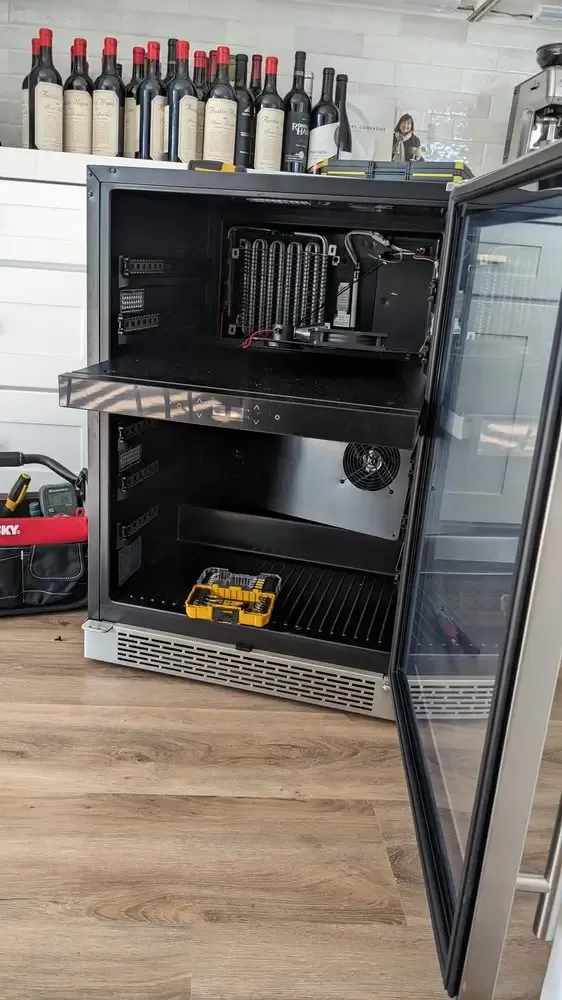
In short: make sure the display is not in showroom or demo mode, put a thermometer in a glass of water on a middle rack for a few hours, clear the grille, and push every rack home so the door seals. One zone warm beside a normal one points to a part serving that zone; both zones warm points to air flow, the control or the sealed system. A few warm days rarely hurt wine.
The wine units we repair
- Full-height wine columns. 18, 24 and 30-inch columns, framed, stainless or panel-ready, often beside a matching refrigerator column. Sub-Zero builds them on its Classic, Designer and Integrated platforms; Thermador, Miele, Monogram, Viking, JennAir, Gaggenau and Dacor build them alongside their own refrigerator columns; Bertazzoni sells wine cellar versions of its built-in refrigerators.
- Undercounter wine refrigerators. 15 and 24-inch units under a counter or bar top, with all the machinery on a tray in the base breathing through the toe-kick grille. Outdoor units have their own page: outdoor kitchen refrigeration repair.
- Combination and compact units. Wine columns with drawers below, such as the Sub-Zero IW-30R and IW-30CI, and simple single-zone coolers with a dial thermostat, like the Sub-Zero 315W that Scotsman built.
A wine setting inside a refrigerator, such as Bertazzoni's convertible compartment or the Fisher & Paykel pantry mode near 54°F, is repaired like the refrigerator; see built-in refrigerator repair. Sub-Zero lines by serial era are on Sub-Zero wine storage repair.
How a wine unit differs from a refrigerator
- One compressor often serves two zones. On most dual-zone Sub-Zero units and on Bertazzoni cellar models, a solenoid valve sends refrigerant to whichever zone asks for cold.
- Defrost without a heater. The evaporator is allowed to warm above freezing each time the compressor rests, which keeps the cabinet humid enough for corks. A leaking door lets frost build faster than those rests can clear it.
- A small refrigerant charge. A wine column or undercounter unit holds only a few ounces, so even a slow leak soon shows as a warm cabinet.
- Two sensors per zone. Electronic units read the air and the evaporator in each zone. A sensor that drifts a few degrees leaves a zone off target without any code.
What you can check before you call
- Rule out a display mode. Showroom or demo mode keeps the lights and display on while the cooling stays off, and units reinstalled after a remodel are often left in it. A reading of 13 where you expect 55 is just Celsius.
- Measure the wine, not the air. Put a thermometer in a glass of water on a middle rack and read it after three or four hours. Air readings jump every time the door opens.
- Clear the grille. With the breaker off, vacuum the toe-kick or top grille, and move rugs, bins or a pet bed away from the opening.
- Check the door. Push every rack all the way in, make sure no bottle touches the glass, and let the door swing closed from halfway. It should pull itself shut.
- Think about the room and the load. Compact units like the 315W are rated for rooms of about 50 to 100°F. A cabinet just restocked with warm bottles can run for up to a day before it settles.
What usually goes wrong
Air flow at the condenser
What it usually is: a grille matted with lint and pet hair, a dusty condenser, or cabinetry with no path for the warm air the unit pushes out. Both zones creep up together and the compressor barely stops.
What you can check: the grille and the space in front of it, breaker off.
What we do: clean the coil and fan, check that warm air is not pulled straight back in, and measure the recovery. See the condenser cleaning guide and annual maintenance.
A zone fan that ticks, buzzes or stops
What it usually is: the small fan moving air across one zone's evaporator wears out, or its blade shifts and rubs. Weeks of ticking is the usual warning; a quiet fan alone proves nothing, since many run only while their zone cools.
What you can check: listen inside the warm zone. Do not reach behind the fan cover.
What we do: test the motor and the control output, replace the fan and set the blade clear of its shroud.
Sensor, keypad or control
What it usually is: a failed or drifting sensor, a corroded connector, a dead keypad or a board relay that no longer switches. Sub-Zero LED controls show EE in place of a zone temperature, which on several lines stops cooling in both zones; Bertazzoni cellar models show a "too warm" or "too cold" alarm, and a separate "Service required" message with a three-digit code when a part fails.
What you can check: write down any code before switching anything off, and compare the display with your glass of water.
What we do: read the stored faults and sensor values, test the wiring to the board and replace what failed. Meanings vary by model and era; see wine storage error codes.
One zone too cold, the other too warm
What it usually is: the valve that steers refrigerant between zones has stuck, or the control drives it wrong. It looks like two failures and is one.
What you can check: only the pattern. Tell us which zone is which when you call.
What we do: run the valve by hand from the control and test its coil and the board. A stuck valve body means opening the sealed system and recharging it by weight.
Door, gasket, glass, hinges and slides
What it usually is: a flattened gasket, a hinge or closer worn by a heavy panel, a cabinet out of level, or rack slides that bind under full racks. Damp air frosts the coil and the meltwater can overflow the drain.
What you can check: close a strip of paper in the door at several points; it should drag as you pull it out. Never pull several loaded racks out at once, because a column can tip.
What we do: replace the gasket or slides, adjust the hinge and closer, level the cabinet and clear the drain.
Sealed system: leak or compressor
What it usually is: a slow leak at an evaporator or joint, or a compressor that no longer pumps. Both zones fade together. Less common, and the repair that most changes the decision.
What you can check: nothing. If the grille is clean, the fans run and the door seals, call.
What we do: confirm with pressure and temperature readings, find the leak before recharging, and quote in writing. We are EPA-certified for refrigerant work and do it in-house; see sealed-system repair.
Protecting the wine, and how we work
Keep the door shut: a full, closed cabinet changes temperature slowly. If you move bottles, use the coolest interior room, not the garage, and if one zone is heading toward freezing, empty that zone first.
We work through the grille, kickplate or interior and leave the bottles where they are. Columns are anchored against tipping, so we pull one out only when the repair needs it, say so first, and protect the floor and panels. Brand-specific parts usually arrive in a few business days, and we tell you the lead time before you decide.
| What failed | Repair or replace |
|---|---|
| Fan, sensor, gasket, hinge, slide, keypad or board | Repair, while the part is made. |
| Zone valve, leak or compressor, unit under about 15 years | Usually repair, especially on a panel-ready column that matches the kitchen. |
| Leak or compressor on an older compact or single-zone unit | Weigh it against a new unit; we say plainly what we would do. |
Before replacing, check that a new model fits the opening and takes your panel; see repair or replace a built-in refrigerator.
What wine refrigerator repair costs
The service call is $79, covers the trip and the diagnosis, and is applied to the repair when you approve the written price, which does not change once work starts. Seniors and veterans get 20% off, repeat customers 15%.
Wine storage and undercounter refrigeration repair
| Repair | Typical price, parts and labor |
|---|---|
| Fan motor | $300 to $550 |
| Temperature sensor | $250 to $450 |
| Door gasket | $300 to $550 |
| Control board or display | $550 to $1,100 |
| Drawer slide or door hinge | $300 to $600 |
| Sealed-system repair (leak, compressor) | $1,200 to $2,800 |
Typical Orange County ranges for parts and labor. The $79 service call is applied to any of them. Parts that ship from the manufacturer and older or discontinued models can run higher. You get the exact written price after the diagnosis and before any work starts.
All ranges are on the pricing page, and our other work is listed under services. To book, contact us with the model number from the tag inside the cabinet.
Talk to the technician first
Monday to Saturday, 8 AM to 7 PM. The $79 service call is applied to the repair.
Wine refrigerator repair: questions
What temperature should a wine refrigerator hold?
For long-term storage most collectors keep it near 55°F, with a second zone set cooler for whites and sparkling if the unit has one. Steady matters more than the exact number.
Why is my wine cooler running all the time?
Most often a clogged grille or condenser, a room that is too warm, or a door that does not seal. If those check out, a weak compressor or a slow leak is next.
Why is the glass door on my wine refrigerator fogging up?
Light fog across the glass on a humid day is normal. Fog along one edge every day means warm air is getting in there, usually through a worn gasket, a sagging door or a rack holding it open.
My wine unit reads 55 but the bottles feel warm. Which is right?
Trust a thermometer in a glass of water left on a rack for a few hours. If it disagrees with the display by more than a couple of degrees, suspect a sensor or its connection.
Do you repair wine refrigerators that are not Sub-Zero?
Yes, including Thermador, Miele, Monogram, Viking, JennAir, Gaggenau, Dacor and Bertazzoni. We are an independent service, not affiliated with any of them; if your unit is still under the maker's warranty, call the maker first.
Can you just add refrigerant to my wine cooler?
Not without finding the leak. These units hold only a few ounces, so a low charge means a leak somewhere, and topping it up without repairing it means paying twice. We repair the leak, then recharge by weight.
How long can wine stay in a unit that stopped cooling?
With the door closed, a full cabinet warms over many hours, and a few days at the temperature of a cool house rarely harms most wine. Weeks of heat and freezing are what to avoid.