Monogram · Wall Ovens
Monogram Wall Oven Repair
Monogram 30-inch convection wall ovens, single and double, in Professional and integrated styling, and the built-in microwaves installed next to them. Most repairs are a hidden bake element, the sensor, the latch, the cooling fan or a control board; on microwaves, a magnetron or a door switch.
$79 service call, applied to the repair. Monday to Saturday, 8 AM to 7 PM.
- $79service call, applied to the repair you approve
- In-housesealed-system work: compressors, evaporators, leaks
- Since 2022CA BHGS #50388, EPA-certified
- 90 daysno-fee return visit if the same fault comes back
In short: a Monogram ZET wall oven heats with six elements under one electronic control; on a double, each cavity has its own relay board, sensor and latch. The usual calls: a slow, uneven bake, a door that stays locked, or an F9 shutdown.
Which Monogram wall oven do you have
Open the door and look at the front left of the oven frame for the tag. The serial dates the oven, and the date tells us which parts fit.
- ZET, 30-inch electric convection. Sold as single and double ovens. A P in the model is the Professional style, with heavier knobs and handle; an S is the integrated stainless style.
- The controls. A mode knob, a temperature knob from Warm to 550°F, a small push-to-enter knob, and buttons for Probe, Timer, Clock, Cook Time and Delay Start. Except for proof, both main knobs must be set before the oven runs.
- Newer models. Later Monogram wall ovens use touch controls; we confirm their parts by model and serial.
How a ZET wall oven is built
- Six elements. An inner and outer bake element hidden under the floor, an inner and outer broil element in the ceiling, and an inner and outer convection ring around a fan that reverses direction. Each pair is one part, and preheat takes about 10 to 15 minutes.
- Three broil modes. Dual broil uses both broil elements, standard broil only the inner one for a smaller load, and convection broil both plus the fan. None of them runs with the meat probe plugged in.
- Venting. Above the door on the left, a small fan draws oven air through a smoke-eliminating catalyst and out the front.
- Cooling and protection. A cooling fan above each oven starts when the cavity reaches about 200°F and runs on after you switch off. A heat switch on the vent cuts power to the relay boards if that area overheats or the fan fails, and a thermal cutoff opens if an element runs away; both reset once cool.
- Control and latch. The knobs and buttons feed a main control board, each cavity has its own relay board for the elements, and a motor-driven latch holds the door shut during self-clean.
What fails on a Monogram wall oven, most common first
Hidden bake element burned out
What it usually is: the bake element under the floor opened, often during or just after a self-clean. The other elements still heat, so the signs are a slow preheat, pale bottoms and uneven baking.
What you can check: time an empty preheat to 350°F, and note whether broil still works.
What we do: test each element. The hidden bake element is one of the few repairs that need the oven slid out of the cabinet, so we plan that visit ahead and protect the cabinetry and floor.
Oven runs hot or cold
What it usually is: a drifting sensor or a poor connection at its plug, or a bake offset someone set long ago from the owner settings. It shifts bake only, not convection or broil.
What you can check: a good oven thermometer on a middle rack, read several times after the preheat beep.
What we do: compare the control's reading with our meter, check the offset, and replace the sensor, which comes out from inside the cavity.
Door locked after self-clean, or LOCKED keeps flashing
What it usually is: the latch motor or a latch switch, or the door switch telling the control the door is open. After a clean the door stays shut until the oven falls to about 450°F; a full clean runs five hours with its cooldown.
What you can check: wait out the cycle and cooldown, and make sure the door closes fully against the gasket. Never pry the door.
What we do: test motor and switches and replace the latch from the control area above the oven, at most easing the oven forward to spare the trim.
F9 on the display and the oven stops heating
What it usually is: a cooling fan that stalled or slowed, so the heat switch cut the relay boards. A blocked vent above the door can cause it too.
What you can check: nothing blocking the vent trim above the door, and, with the oven hot, the sound of the fan above it.
What we do: test the fan and the heat switch and replace what failed. The cooling fan comes out from the front.
Display dark, knobs ignored, or a C code
What it usually is: the control lockout left on, a failed power supply or logic board, or an encoder that lost contact with the logic board. A stuck button pad shows up as a stored key fault.
What you can check: Loc on the display (hold Cook Time and Delay Start together for three seconds to unlock), a flashing clock after a power cut, and the oven's double breaker switched fully off and back on.
What we do: check the low-voltage supply to the logic board, which tells a dead supply board from a dead logic board, then the harnesses and encoders.
Convection fan silent or noisy
What it usually is: the fan motor or its run capacitor. The fan pausing, changing direction, or stopping when the door opens is normal.
What we do: test motor and capacitor; the fan and convection element come out from inside the oven.
What the oven tells you
For the ZET dial-control ovens; meanings vary by model and era. A fault is shown only after it happens twice in a row, and F9 is the only code an owner normally sees.
| Code or display | What it usually means | What to do |
|---|---|---|
| Loc when you set the oven | Control lockout is on | Hold Cook Time and Delay Start for three seconds |
| Flashing time of day | The power went out | Reset the clock |
| LOCKED flashing | The latch motor is moving the lock | Wait; it stays lit once the door is locked |
| Lights and display work, nothing heats | Half of the 240-volt supply missing, or a thermal cutoff open | Reset the double breaker; if that fails, call |
| Oven off after many hours | The 12-hour automatic shut-off, unless disabled | Normal |
| F9 | Cooling fan stalled or the heat switch opened | Call; the oven cuts heat to protect itself |
The control keeps its last seven faults for a technician. On ZET ovens they cover an overheat (F2), the sensor (F3, F4), a stuck key (F7), the latch (FC), and a lost link between the logic board and a relay board or knob (C1 to C6). Codes for other brands are on the error codes page.
Monogram microwaves and speed ovens
Many Monogram wall ovens share a cabinet with a built-in microwave or speed oven. The usual faults: it runs but does not heat (magnetron, high-voltage diode, capacitor or transformer), it dies after a hard door close (an interlock switch or its fuse), or the keypad stops answering.
A quick owner check is a cup of water heated for one minute: if it comes out cold while everything else runs, the heating circuit has failed. In July 2026, in Orange County, we repaired a built-in GE Monogram microwave that ran but did not heat: GE Monogram Microwave Not Heating: Magnetron Fix. More on microwave and microwave drawer repair.
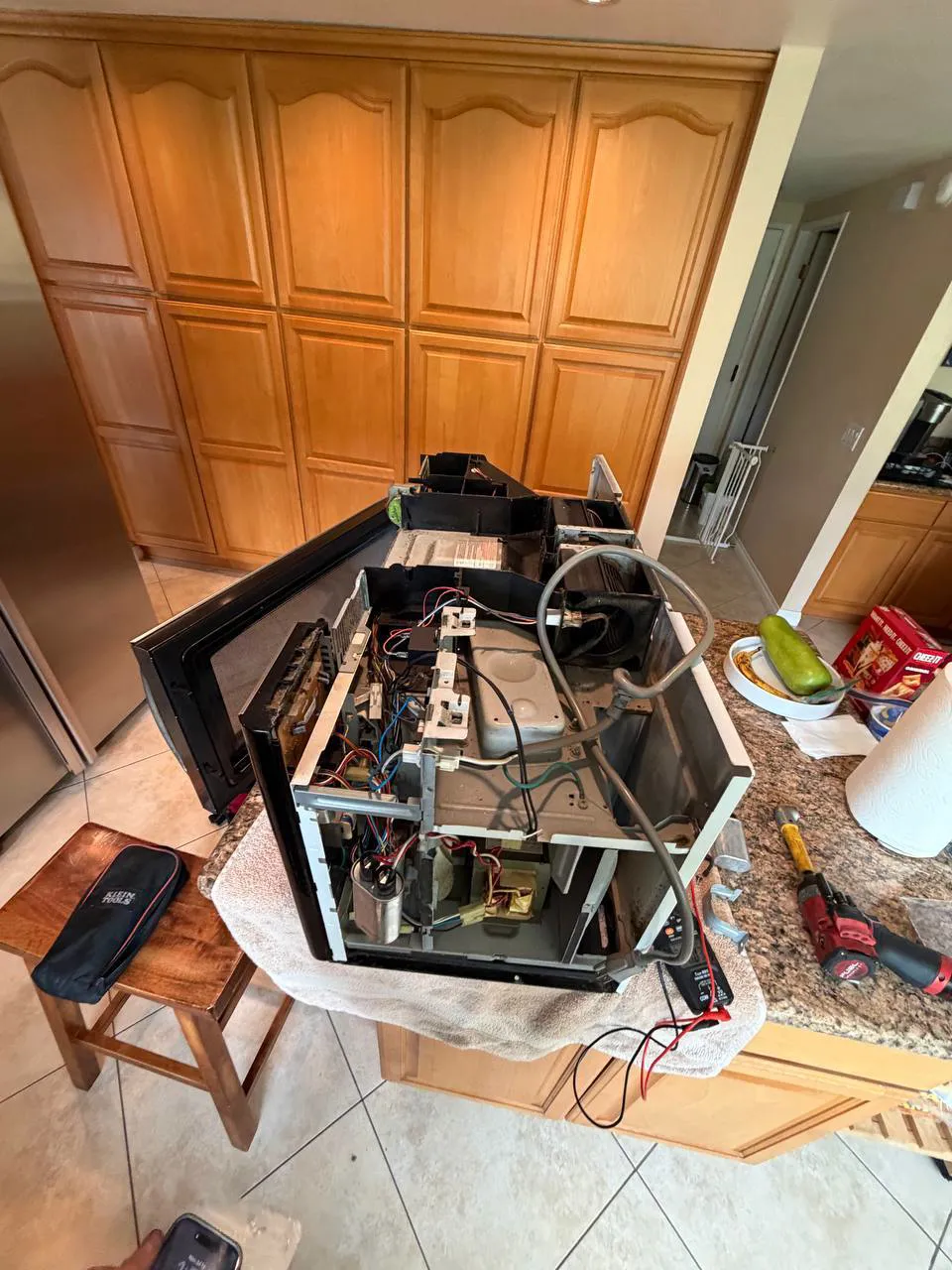
Stay safe. A microwave keeps a dangerous charge in its capacitor even unplugged, so never remove its cabinet. Do not slide a wall oven out yourself; it is heavy, wired to a 240-volt circuit and held in the cabinet by screws. Self-clean fumes can harm pet birds.
Repair or replace a Monogram wall oven
| What failed | Our usual advice |
|---|---|
| Element, sensor, latch, cooling fan, convection motor, gasket, hinges | Repair. Heat, self-clean and daily use wear these out. |
| Logic, power supply or relay board, knob encoder | Usually worth repairing; we confirm the exact board for your serial and its lead time first. |
| Microwave magnetron or door switches | Repair in most built-in units. |
| Cracked oven liner, several boards at once, controls no longer made | Consider replacing; a new oven must match the cutout. |
What a Monogram wall oven repair costs
The $79 service call covers the trip and the diagnosis and comes off the repair once you approve the written price. Brand-specific parts such as a ZET bake element or relay board come from a distributor or the manufacturer, usually in a few business days, and we tell you the lead time before you decide.
Wall oven and steam oven repair
| Repair | Typical price, parts and labor |
|---|---|
| Oven temperature probe | $250 to $450 |
| Bake or broil element | $350 to $700 |
| Convection fan motor or element | $400 to $750 |
| Door lock motor or switch | $350 to $650 |
| Door hinge or glass | $350 to $750 |
| Steam oven descale and water-system service | $300 to $600 |
| Steam generator or pump | $600 to $1,200 |
| Electronic control board | $700 to $1,600 |
Microwave drawer and speed oven repair
| Repair | Typical price, parts and labor |
|---|---|
| Drawer motor or drive mechanism | $400 to $800 |
| Door switch set | $300 to $550 |
| Magnetron | $450 to $800 |
| Control board | $550 to $1,000 |
Typical Orange County ranges for parts and labor. The $79 service call is applied to any of them. Parts that ship from the manufacturer and older or discontinued models can run higher. You get the exact written price after the diagnosis and before any work starts.
See also wall oven repair, pricing, Monogram repair and Monogram ranges. Comparing brands: Wolf, Viking and Thermador wall ovens.
Talk to the technician first
Monday to Saturday, 8 AM to 7 PM. The $79 service call is applied to the repair.
Monogram wall ovens: questions
Why does standard broil heat only the middle of the pan?
Standard broil uses only the inner broil element, for a small load. Dual broil adds the outer element for a full pan, and convection broil adds the fan.
Why does steam come out above my Monogram oven door?
That is the oven vent, which draws air out through a smoke eliminator. Steam and a warm trim there are normal; keep the vent uncovered.
Can I bake in one oven while the other self-cleans?
Yes, on the double oven. If you set both to clean, the second waits until the first has cooled to about 400°F.
Does a Monogram wall oven have to come out for repair?
Most repairs do not: broil and convection elements, sensor, fan, latch and boards are reached from the front or inside. The hidden bake element and a few parts behind the side panels need the oven slid out.
Why are my oven racks hard to slide?
The full-extension racks run on graphite lubricant that wears off over time. Wipe out debris and relubricate with the graphite made for them, never cooking spray.
Is a Monogram built-in microwave worth repairing?
Usually. A magnetron or door switch costs less than a new built-in with matching trim.