Wolf · Cooktops
Wolf Gas and Induction Cooktop Repair
Wolf gas cooktops and rangetops use the same stacked sealed burners as the ranges, and their faults are mostly ignition, flame and simmer problems. Induction cooktops fail differently, in their power boards, coils and cooling fans. Both are usually repaired from above and from the cabinet below, without disturbing the countertop.
$79 service call, applied to the repair. Monday to Saturday, 8 AM to 7 PM.
- $79service call, applied to the repair you approve
- In-housesealed-system work: compressors, evaporators, leaks
- Since 2022CA BHGS #50388, EPA-certified
- 90 daysno-fee return visit if the same fault comes back
In short: on a gas Wolf, a burner that clicks, lights late, burns yellow or pops on simmer is almost always seating, moisture, dirt or an ignition part at that one burner. On induction, check the pan and the air flow underneath first; past that, it is the electronics. A gas smell is never an owner check.
Which Wolf cooktop you have
- Gas cooktop. Drops into a counter cutout, with an outlet in the cabinet below that powers the spark.
- Gas rangetop. A Wolf range top without the oven, knobs on a front panel. Wider models add an infrared griddle, a charbroiler or a French top.
- Induction cooktop. A glass top over coils, with power boards and cooling fans underneath, on a 240-volt circuit.
The rating label is usually under a cooktop, seen from the cabinet below, and under the front panel of a rangetop. If the burners sit over an oven, see Wolf range repair; cooktops are often paired with Wolf wall ovens.
How a Wolf gas burner works
Each burner is two stacked in one. The upper ports give the full flame; push the knob in past LOW and the gas moves to smaller ports under the cap. That lower tier gives the Wolf simmer: the flame stays wide and lit while the heat drops, rather than cycling on and off. So a simmer that clicks, flickers out or pops is a fault.
Each burner's valve has its own switch that starts the spark, so a clicking fault usually traces to one burner; when every burner goes quiet, check power first. A burner that goes out relights itself. Range generations are on Wolf range repair.
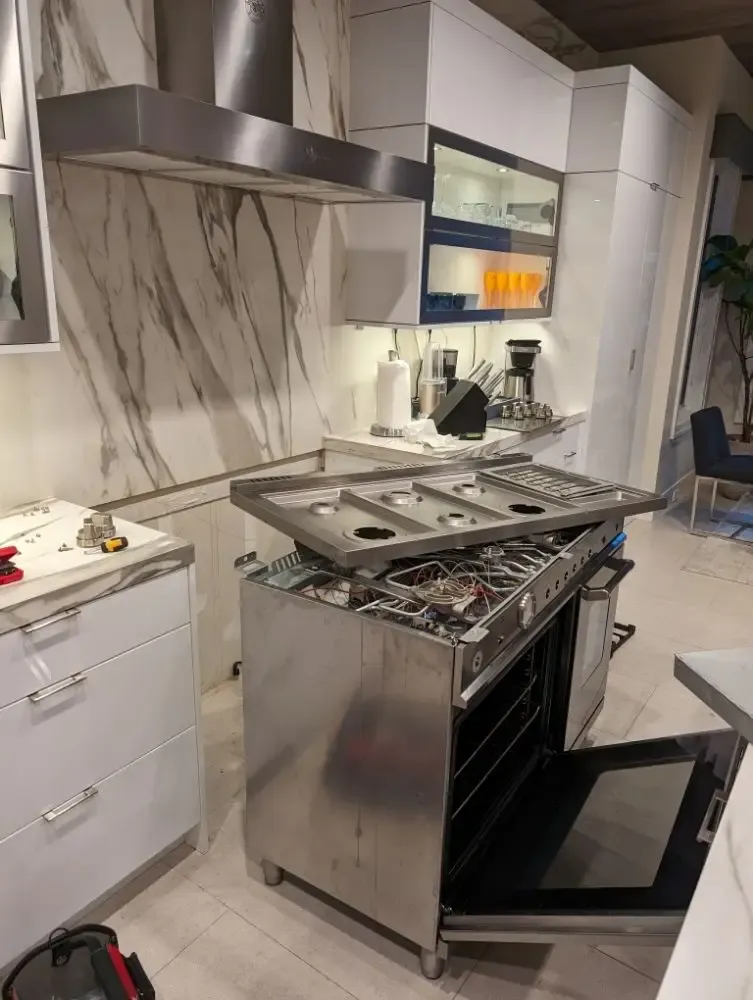
Safe checks for a gas top
- Reseat the cap. With the top cold, set the cap back and turn it gently until it drops flat into its notch. An off-center cap is a common cause of late lighting.
- Dry it out. After a boil-over or wet cleaning, give the burner a day before blaming a part.
- Clean it right. Let the caps cool, wash them at the sink with dish soap and dry them completely. Clean acidic or sugary spills the same day, before they mark the enamel. Keep cleaner off the ceramic igniter.
- Look at the flame. Steady and blue with small, even cones. Note yellow tips, lifting or roaring.
- Check power and gas service. No spark anywhere: the breaker and the outlet below. Sparks but no flame: see whether your other gas appliances light. If none do, call the gas company; if they do, leave the cooktop off and call us.
What fails on a Wolf gas cooktop or rangetop
One burner clicks and will not stop
What it usually is: moisture or grease in that burner's valve switch, or a worn switch stuck closed. Less often a damaged igniter wire or a failed spark module. A receptacle that is not grounded or polarized correctly can set the whole top sparking.
What you can check: a day of drying and the cap seated. If it persists, switch off the breaker or unplug the top under the counter.
What we do: isolate switch, lead and module and replace the faulty one. More on clicking in Wolf burner not lighting.
A burner lights late, or only on HIGH
What it usually is: most often the cap is not sitting flat or the ports are clogged from a boil-over. Next comes a dirty or cracked igniter. On older burners a worn part inside the burner can do the same, and a weak spark module is the least likely.
What you can check: cap position and clean, dry ports. Do not poke the igniter or drill out ports.
What we do: clean or replace the burner parts and electrode, and renew the seals on older burners whenever they come apart.
Yellow, tall, lifting or pulsing flames
What it usually is: a burner part that is out of place or dirty, air blocked around the burner, or a cooktop set up for a different gas than your house has. When every burner looks wrong at once, a propane conversion or a move from a propane house is a common cause.
What you can check: heads and caps seated and the openings around the burner box clear. Leave orifices and the regulator alone.
What we do: confirm the cooktop is set up for your gas, check the supply and replace damaged burner parts. Yellow, tall flame means incomplete burning, so leave those burners off until they are checked.
Popping or going out on simmer
What it usually is: usually the burner parts are not sitting flat, or food has blocked the small simmer openings. On older burners a worn seal or a damaged part under the cap can do it.
What you can check: reseat and clean, then retry with the hood on low; a strong draft can disturb a small flame.
What we do: replace the damaged part and confirm a quiet, steady simmer at the lowest setting.
Stiff knob, or gas smell at a knob
What it usually is: a valve worn inside or gummed by spills that ran behind the knob. A knob that no longer pushes in to reach simmer is often the valve too.
What you can check: nothing beyond wiping the knob; never soak or force it. If you smell gas, leave and call from outside.
What we do: replace the valve, and its switch if needed, and leak-test every fitting.
A rangetop griddle, charbroiler or French top works like the one on a Wolf range; its ignition reset and common faults are on Wolf range repair. A griddle light cycling at temperature is normal.
Wolf induction cooktops
A coil under the glass makes a magnetic field that heats the pan itself. Power boards drive the coils, and fans cool the boards, often running on after you finish. Fault displays vary by model, so we keep this general and read them on the visit.
A zone will not heat, or shows a pan symbol
What it usually is: a pan the cooktop cannot detect: not magnetic, too small or warped. If one zone ignores every pan, its coil or its board section has failed.
What you can check: a magnet sticks firmly to the pan base, the base covers most of the ring, the control lock is off and the controls are dry.
What we do: test the zone with a known pan, then the coil and board.
Zones shut off while cooking
What it usually is: overheating protection. Blocked air underneath, a drawer packed against the underside, or a failing fan lets the electronics run hot, and the control cuts power.
What you can check: clear space under the cooktop and listen for the fans while cooking.
What we do: replace a weak fan and check the air path and board temperature.
Half the cooktop dead, or the breaker trips
What it usually is: a failed power board or its fuse, often after a surge or years of heat, or a loose connection to that board. A missing leg of the 240-volt supply usually leaves the whole cooktop without heat.
What you can check: reset the breaker once. If it trips again, leave it off and call.
What we do: measure the supply and board outputs, then replace the board or repair the connection.
A hum or buzz at high power is normal with many pans. Cracked glass is not: stop using the cooktop, since spills can reach the electronics, and the fix is a new glass top assembly.
Stay safe. If you smell gas, leave the house and call the gas company or 911 from outside. Do not lift a cooktop out of its cutout, open the burner box, adjust orifices or touch the gas connection. Induction boards hold stored energy, so the underside stays closed.
Repair or replace a Wolf cooktop
| What failed | Our usual advice |
|---|---|
| Igniter, switch, spark module, burner parts or a valve | Repair. These are wear parts, and most are available. |
| Induction fan, coil or one power board | Usually repair, once the part for your model is confirmed. |
| Cracked induction glass, electronics sound | Possible; compare the glass assembly price with a new unit first. |
| Cracked glass plus failed boards on an older unit | Usually replace. The new one must fit the existing cutout. |
What Wolf cooktop repair costs
The service call is $79 and is applied to the repair when you approve the written price. Igniters and switches are often on the van; Wolf boards and coils usually take a few business days.
Cooktop repair (gas and induction)
| Repair | Typical price, parts and labor |
|---|---|
| Igniter or spark switch | $250 to $450 |
| Spark module | $300 to $600 |
| Burner valve | $350 to $650 |
| Induction cooling fan | $350 to $650 |
| Induction coil | $500 to $1,000 |
| Induction power board | $650 to $1,400 |
Typical Orange County ranges for parts and labor. The $79 service call is applied to any of them. Parts that ship from the manufacturer and older or discontinued models can run higher. You get the exact written price after the diagnosis and before any work starts.
Other brands: cooktop repair and professional range repair. Every published range is on pricing, and the other Wolf lines on Wolf repair.
Talk to the technician first
Monday to Saturday, 8 AM to 7 PM. The $79 service call is applied to the repair.
Wolf cooktops: questions
Why is my Wolf simmer flame almost as wide as the full flame?
That is the design: the simmer tier keeps the flame spread across the burner while cutting the heat. A small, uneven or noisy simmer flame is what needs attention.
Do I need special pans for a Wolf induction cooktop?
They must be magnetic, with a flat base close to the ring size. Cast iron, enameled steel and stainless pans with a magnetic base work; many all-stainless pans, plain aluminum, copper and glass do not. If a magnet sticks firmly to the base, the pan will work.
Can a cracked induction glass top be repaired?
The glass is replaced as an assembly, not patched. Whether it pays depends on the cooktop's age and its boards, and we give you that comparison in writing.
Why does my induction cooktop hum or buzz?
At high power many pans vibrate slightly in the magnetic field, which is normal. Grinding from the fans, or loud clicking with no pan on, is worth a visit.
Could a propane conversion cause yellow flames on my Wolf?
Yes. Each gas needs its own orifices and pressure, so if every burner turned yellow or tall after a conversion or a move, the conversion is checked first.
Do you repair Wolf rangetops as well as cooktops?
Yes, including the griddle, charbroiler and French top on wider rangetops, usually repaired in place.