Sub-Zero · Troubleshooting
Sub-Zero Running Constantly
A Sub-Zero that seems to run all the time is often just doing its job: newer units run long and slow by design, and two systems take turns. When it truly never stops, the usual reasons are a dirty condenser, a leaking door, an iced coil, low refrigerant or a control holding the compressor on.
$79 service call, applied to the repair. Monday to Saturday, 8 AM to 7 PM.
In short: long, quiet runs are normal on later Sub-Zero units with variable-speed compressors, and two systems take turns. It is a problem when a section will not hold its set point, the top runs hot and loud for hours, or the Service icon flashes. Clean the condenser, check that every door closes on its own, and make sure Max Ice is off.
What normal running looks like
- Variable-speed compressors. Later Classic Series units, the PRO 48 and many Integrated models use compressors that change speed, running slowly for long stretches instead of starting and stopping often. A low, steady hum for most of the hour is normal.
- Two systems. Combination models have one compressor for the refrigerator and one for the freezer, each on its own schedule. The single condenser fan at the top runs whenever either one is on, so the fan can seem to never stop.
- Recovery. After a grocery load, a door left ajar, a defrost or a power outage, a compressor runs long to catch up; from warm, it can take most of a day.
- Max Ice. Several ice cube icons mean the freezer is held at minus 5°F with its fan on for 24 hours, so the freezer compressor works much harder that day.
- A hot room. Sub-Zero built-ins are meant for rooms between roughly 60 and 90°F. Afternoon sun, a range right beside the unit or a summer garage add hours of run time; outdoor kitchens need outdoor-rated units, see outdoor kitchen refrigeration.
How the control decides it is running too long
Newer Sub-Zero controls keep track of how long each compressor runs. On Classic Series and Integrated units, a compressor that keeps running for hours at a stretch makes the control start a defrost in case ice is the cause and flash the Service icon. If the compartment still does not come down, the alarm chimes as well. Touch-screen Integrated models show a message when the door opens.
On 600 series units after serial 2600000, 700 series units and UC-24 undercounters, a flashing SERVICE usually means a compressor ran too long or a compartment drifted out of range; a steady one usually means stored codes were never cleared. See Sub-Zero Service light and Sub-Zero error codes.
What you can check
- Find out which side is running. Running nonstop with both sections cold, or the refrigerator getting colder, points at the control; see refrigerator freezing food. Running nonstop with one side warm points at that side's system; see freezer not freezing and not cooling.
- Clean the condenser. Breaker off, top grille open, brush and vacuum the coil until you can see light through it. The condenser cleaning guide walks through it.
- Clear the air path. Full-size built-ins breathe through the top grille, undercounter and drawer units through the toe-kick. Trim added over a grille, or a rug against a toe-kick, traps hot air.
- Test every door and drawer. Open each halfway and let go; it should close and seal by itself. Then shut a sheet of paper in the door at the top, middle and bottom on both sides: it should drag as you pull it out. Where it slides out freely, air is leaking in. See door not closing.
- Read the display. Check for Max Ice, and for set points at the very bottom of their range, which a warm kitchen makes hard to reach.
- Feel the air at the grille. Warm air while a compressor runs is normal. Hot air, a smell of hot dust, or no condenser fan sound while a compressor is clearly running is not.
What keeps a Sub-Zero running
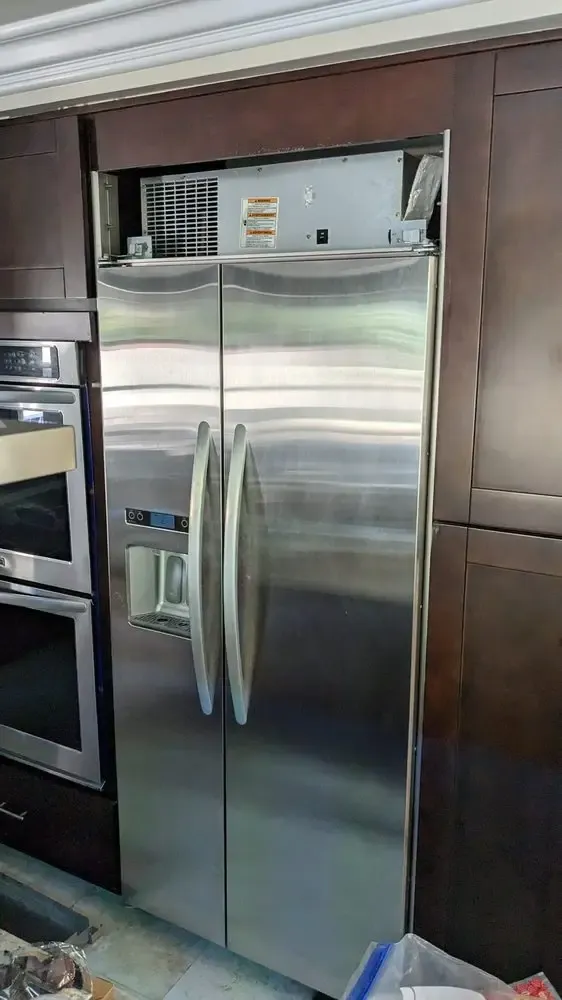
Dirty condenser or a failing condenser fan
What it usually is: the compressor gets rid of the heat it pulls from the cabinet through the condenser at the top. Dust and grease on the coil, or a fan slowed by worn bearings, leave that heat nowhere to go, so the compressor runs longer and hotter for the same result. It is the most common cause of long run times, and over the years it shortens compressor life.
What you can check: the coil, with the power off, and whether the fan runs.
What we do: clean the coil, check the fan and its blade position, and check the compressor for heat damage. Near the ocean we also look at the fins and the fan motor for salt corrosion.
Warm air getting in
What it usually is: any gap at a door or drawer lets warm, humid air in, and the compressor has to run longer to remove that heat and moisture. A heavy custom panel wears the hinge closer faster.
What you can check: the paper test above, and frost or sweat along one edge of a door.
What we do: find the leak with the paper test and a thermometer, then fix it as described in door not closing.
Iced coil or a stopped evaporator fan
What it usually is: a freezer defrost failure, blocked air openings, or a worn fan inside the compartment. Either way air stops moving across the coil, and the compressor runs on without getting the cabinet cold. Because newer controls force a defrost after long runs, a weak defrost can seem to fix itself for a while before the long runs return.
What you can check: frost on the back wall, water under the crispers, or a new noise from inside. See frost buildup and Sub-Zero making noise.
What we do: find the failed defrost part or fan, repair it, and thaw the coil completely.
Low charge, a weak compressor or a restriction
What it usually is: a slow leak that leaves too little refrigerant to carry heat away, a compressor that runs but no longer pumps well, or a partial blockage. Run times stretch over weeks and the section creeps warmer. Sub-Zero systems hold their charge in ounces, so even a small leak shows, and only the pressures tell these three apart.
What you can check: nothing safely. A unit that ran normally for years and now runs nonstop with a clean condenser and good seals is a candidate.
What we do: confirm with gauges and temperatures, quote in writing, and do the leak or compressor repair in-house, with a new drier and a weighed charge. Our post Sub-Zero Refrigerator Not Cooling? Evaporator Leak Fix (July 2026, Irvine) shows one such repair; see also sealed-system repair and compressor replacement.
Control holding the compressor on
What it usually is: the control keeps the compressor on even though the section is already cold. The giveaway is a section colder than its set point with the compressor still running; refrigerator freezing food covers the sensor and board faults behind it.
What you can check: raise the set point two degrees and see whether the compressor ever pauses that day.
What we do: test the sensor and the board output and replace or reconfigure what is wrong.
Leave it running while you wait. Switching the unit off and on does not clear whatever is making it run long, and after a restart the compressors wait a few minutes before they start, so cycling the power only adds hard starts. Never open the top grille with the power on: the condenser fan and live connections sit right behind it. If the food is warming, move perishables to a cooler and call.
What it costs, and what waiting costs
The service call is $79 and is applied to the repair when you approve the written price. For long run times, the condenser cleaning, condenser fan, gasket, hinge closer and defrost rows cover most visits; the sealed-system rows apply when the charge or the compressor is the cause.
Built-in refrigerator and freezer repair (Sub-Zero, Thermador, Viking, Monogram, Miele)
| Repair | Typical price, parts and labor |
|---|---|
| Condenser cleaning and performance check | $150 to $250 |
| Condenser fan motor | $350 to $600 |
| Evaporator fan motor | $350 to $650 |
| Temperature sensor (thermistor) | $250 to $450 |
| Defrost heater or defrost termination | $350 to $650 |
| Water valve | $300 to $550 |
| Door gasket, per door | $300 to $600 |
| Door hinge or closer cam | $300 to $650 |
| Ice maker assembly | $450 to $900 |
| Electronic control board | $650 to $1,300 |
| Refrigerant leak repair and recharge | $900 to $2,000 |
| Evaporator replacement | $1,200 to $2,500 |
| Compressor replacement (sealed system) | from $2,000 |
Typical Orange County ranges for parts and labor. The $79 service call is applied to any of them. Parts that ship from the manufacturer and older or discontinued models can run higher. You get the exact written price after the diagnosis and before any work starts.
Nonstop running costs electricity, but the bigger cost is heat and wear on the compressor. A yearly maintenance visit that cleans the condenser and checks the seals helps keep run times normal. See pricing, built-in refrigerator repair and the Sub-Zero repair overview.
Talk to the technician first
Monday to Saturday, 8 AM to 7 PM. The $79 service call is applied to the repair.
Sub-Zero running constantly: questions
How long should a Sub-Zero compressor run?
There is no single number. Variable-speed units can run most of the hour at low speed, while older units cycle on and off. Classic Series and Integrated controls flag a compressor that keeps running for hours without a break.
Is it normal to hear my Sub-Zero running all the time?
A low, steady hum and the condenser fan at the top are normal much of the time, especially on units with two systems. A loud, labored sound, a rattling fan, or running with a section warm is not.
Why does the front of my Sub-Zero feel warm around the doors?
Many built-ins run a warm refrigerant line around the door openings to keep condensation off the frame. Warm is normal; hot, together with long run times, usually means the condenser is struggling.
Will cleaning the condenser stop it running constantly?
Often, if the coil was the cause and the heat did no damage. Give it a day. If it still runs nonstop with good door seals, look at defrost, refrigerant or the control.
Should I turn my Sub-Zero off to let it rest?
No. It does not fix the cause, it lets the food warm, and the compressors wait a few minutes after each restart. Leave it on, keep the doors closed and book a visit.
Does a variable-speed Sub-Zero ever switch off?
Yes, between cycles and during defrost. The pauses can be short and far apart, so long runs with both sections at their set points are normal.