Sub-Zero · Wine storage
Sub-Zero Wine Storage Repair
Most Sub-Zero wine units cool two zones with one small compressor, so the typical fault is one zone drifting warm or cold while the other behaves. We repair the 400 series through current Classic, Designer and Integrated wine, usually in place, with the price in writing first.
$79 service call, applied to the repair. Monday to Saturday, 8 AM to 7 PM.
- $79service call, applied to the repair you approve
- In-housesealed-system work: compressors, evaporators, leaks
- Since 2022CA BHGS #50388, EPA-certified
- 90 daysno-fee return visit if the same fault comes back
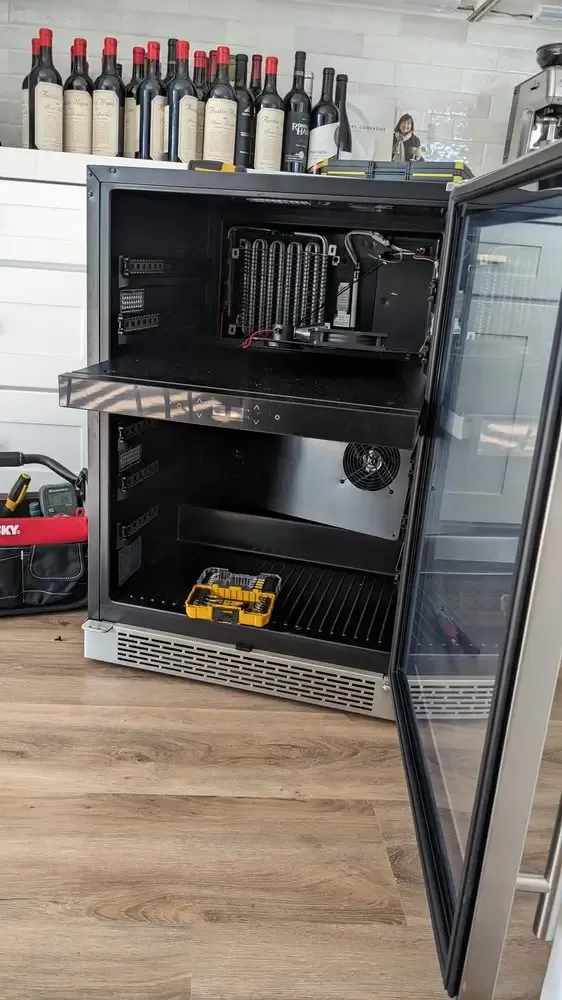
In short: one warm zone beside a normal one usually means a part serving only that zone: its fan, sensors, door seal or feed valve. EE in place of a temperature is a sensor fault that stops cooling on the 400, WS, BW and UW lines. Both zones warm points to the condenser, the control or the sealed system. A day or two a few degrees warm will not hurt most wine; sustained heat and big swings do.
Which Sub-Zero wine unit you have
The line decides the layout, the displays and which parts still exist. Read us the model and serial from the tag inside the cabinet. Other Sub-Zero lines are on the Sub-Zero repair page.
| Line | Models | How to recognize it |
|---|---|---|
| 400 series | 424, 424FS, 427, 427R, 430 | The first electronic Sub-Zero wine units: LED keypad between two zones, BELL and SERVICE lights. Units after serial 2191622 are a second generation with different parts; the 427R adds refrigerator drawers. |
| WS and BW | WS-30, then BW-30 | 30-inch full-height columns on the Built-In (now Classic) platform, framed, overlay, stainless or flush inset. |
| Classic wine | CL3050W | The current Classic Series wine column, overlay or stainless. |
| Undercounter | UW-24, UW-24FS, DEU1550W, DEU2450W | Units that fit under a counter and breathe through the toe-kick grille. The FS version can stand alone. |
| Integrated and Designer | IW-18, IW-24, IW-30, IW-30R, IW-30CI; DEC and DET wine models | Panel-ready columns with an LCD control. The IW-30R adds refrigerator drawers, the IW-30CI refrigerator and freezer drawers. |
| Compact cooler | 315W | A single-zone, two-dozen-bottle unit with a dial thermostat, unlike any other Sub-Zero wine line. |
How they are built, and why it matters
Since the 400 series, almost every Sub-Zero wine unit works the same way. One compressor serves two zones. Each zone has its own evaporator, fan and two sensors, one for the air and one on the evaporator. A solenoid valve steers refrigerant to whichever zone wants cold. Before cooling a zone again, the control lets its evaporator warm above freezing so the frost melts off. Most units therefore have no defrost heater.
A failed compressor takes both zones down together. A stuck valve can leave one zone too cold and the other warm, which looks like two faults and is one. The charge is a few ounces, so a slow leak shows early.
The WS-30, BW-30 and Classic column keep the compressor at the top, like a Classic refrigerator. The 424, UW-24 and Integrated units carry it at the bottom and breathe through the toe kick, so a rug against that grille starves them. The 427R drawers have their own control and keypad. Refrigerator drawers are on the undercounter page, Integrated refrigerator columns on the Integrated page.
What you can check first
- Read the display. Showroom mode keeps the lights on but does not cool. Sabbath mode turns the lights off. A sudden reading like 12 or 14 may only mean the display was switched to Celsius. Write down any EE or code.
- Check the setting carefully. On the 400 series and WS-30, the first press of COLDER or WARMER already moves the setting a degree. On the BW-30 and UW-24 the first press only shows it.
- Clear the grille. With the breaker off, brush and vacuum the toe-kick grille or the top grille and the coil behind it. See the condenser cleaning guide.
- Check the door and racks. A rack not pushed home or a tall bottle can hold the door off its gasket.
- Listen. A zone calling for cold should have a soft fan running. If it beeps, see alarm beeping.
What fails, most common first
Blocked grille or dirty condenser
What it usually is: the top cause on undercounter and Integrated units, which draw air near the floor and collect lint and pet hair fast. Both zones drift warm.
What you can check: the grille and coil, power off, and nothing stacked against the toe kick.
What we do: clean the condenser, check its fan and measure the recovery.
Evaporator fan in one zone
What it usually is: a worn motor or, on the 400, WS, BW and UW lines, a blade knocked out of position, often after weeks of ticking. On 400 series units before serial 1944319 the fans ran constantly with the door shut; later units run each fan only while its zone cools, so a quiet fan is not always dead.
What you can check: listen inside the warm zone. Do not reach behind the fan cover.
What we do: test the motor and its signal and replace it; where the design uses an open blade, we set its spacing. Integrated wine zones use box fans, which are replaced as a unit. See making noise.
Temperature sensor
What it usually is: one of the four sensors has failed or lost its connection. On the LED-display lines (400, WS, BW, UW) a failed zone sensor shows EE and the control stops the compressor and fans. A sensor that only drifts leaves the zone a few degrees off.
What you can check: EE, a SERVICE light, or a thermometer in a glass of water on the rack that disagrees with the display.
What we do: read the sensor values and stored faults, test the wiring and replace the sensor. Displays by line are on the wine storage error codes page.
Refrigerant valve stuck
What it usually is: the valve that feeds the upper or lower zone sticks, so one zone gets all the cooling and runs too cold, sometimes frosting over, while the other warms.
What you can check: which zone is cold and which is warm; that pattern is the clue.
What we do: test the coil and control output and switch the valve between zones. A stuck valve body is replaced, which means opening the sealed system and recharging it by weight.
Door, gasket, hinge and water
What it usually is: a flattened gasket, a hinge or closer worn by a heavy panel, or a cabinet out of level. Damp air gets in, and the extra defrost water can overflow the drain into the zone or under the unit.
What you can check: that the door pulls itself shut from halfway open. Fog along one edge of a glass door every day points to a gap there; light fog over the whole glass on a muggy day is normal.
What we do: replace the gasket, adjust the hinge and closer, re-level, and clear the drain. See door not closing and leaking water.
Keypad, display or control board
What it usually is: dead keys, a loose ribbon cable or a board relay that no longer switches a part. Integrated columns show a wrench and a code when the door opens; the most serious faults also chime with the door shut.
What you can check: whether the keys respond. Note any code before switching the unit off.
What we do: test the keypad and cable before the costlier board. On the oldest 400 series units we check what can still be sourced before you decide.
Sealed system: compressor or leak
What it usually is: a compressor that no longer pumps, or a leak at an evaporator or joint. Both zones fade and the compressor runs nearly nonstop.
What you can check: nothing. If the grille is clean, the fans run and neither zone holds, call.
What we do: confirm with pressure and temperature readings, quote in writing, and do the work in-house; we are EPA-certified for refrigerant work. Sub-Zero lists LOKRING fittings for Integrated wine units and some 400 series models (the 427, and 424 units after serial 3227000), so on those many joints can be made without a torch. See sealed-system repair and compressor replacement.
How we work, and repair or replace
Most parts are reached through the grille, the interior or the toe kick, with floors and panels protected. Wine columns are anchored against tipping, so we pull one out only when needed and say so first; the 315W usually has to come out. If bottles need to come out of a zone, we say so before we start. Sub-Zero parts usually take a few business days.
Fans, sensors, gaskets, hinges, valves and keypads are usually worth repairing on every line where the part can still be found. Sealed-system work makes most sense on BW, UW, Classic, Designer, Integrated and sound WS-30 units. On a 400 series unit over twenty years old with a failed compressor, weigh our written price against a new unit and whether one fits your opening and panels.
What Sub-Zero wine storage repair costs
A visit for a warm zone or a code is $79; it covers the trip and diagnosis and goes toward the repair once you approve our written price.
Wine storage and undercounter refrigeration repair
| Repair | Typical price, parts and labor |
|---|---|
| Fan motor | $300 to $550 |
| Temperature sensor | $250 to $450 |
| Door gasket | $300 to $550 |
| Control board or display | $550 to $1,100 |
| Drawer slide or door hinge | $300 to $600 |
| Sealed-system repair (leak, compressor) | $1,200 to $2,800 |
Typical Orange County ranges for parts and labor. The $79 service call is applied to any of them. Parts that ship from the manufacturer and older or discontinued models can run higher. You get the exact written price after the diagnosis and before any work starts.
Seniors and veterans get 20% off, repeat customers 15%. See pricing, and wine storage repair for other brands.
Talk to the technician first
Monday to Saturday, 8 AM to 7 PM. The $79 service call is applied to the repair.
Sub-Zero wine storage: questions
Why is one zone of my Sub-Zero wine cooler warm while the other is fine?
Both zones share one compressor, so a single warm zone usually means a part serving only that zone. If the other zone is also too cold, suspect the feed valve first.
What does EE mean on a Sub-Zero wine unit?
The control has lost a usable reading from that zone's sensor. On the 400, WS, BW and UW lines it stops cooling until the fault is repaired, so treat it as a service call.
Can you still repair a Sub-Zero 424 or 427?
Usually, yes. Fans, sensors and gaskets can often still be found or replaced with current equivalents, though some original parts are no longer made.
What temperature should a Sub-Zero wine unit be set to?
Most collectors keep long-term storage around 55°F and set one zone cooler for serving whites. Steady matters more than the exact number.
Can you still repair a Sub-Zero WS-30?
Usually, yes. It is built on the older Built-In platform with the compressor at the top; fans, sensors, gaskets and the keypad are the usual repairs. We check what can still be sourced for your serial number before you commit.
My wine unit is still under warranty. Should I call you or Sub-Zero?
Call Sub-Zero first. We are an independent service, not affiliated with Sub-Zero Group; after the warranty ends, we repair Sub-Zero wine units across Orange County, from the 400 series to current models.