Sub-Zero · Classic Series
Sub-Zero Classic Series (BI) Repair
Side-by-sides, over-and-unders, French doors and single columns, all with the machinery behind the top grille. A good repair starts with the model, the serial era and what the display shows.
$79 service call, applied to the repair. Monday to Saturday, 8 AM to 7 PM.
- $79service call, applied to the repair you approve
- In-housesealed-system work: compressors, evaporators, leaks
- Since 2022CA BHGS #50388, EPA-certified
- 90 daysno-fee return visit if the same fault comes back
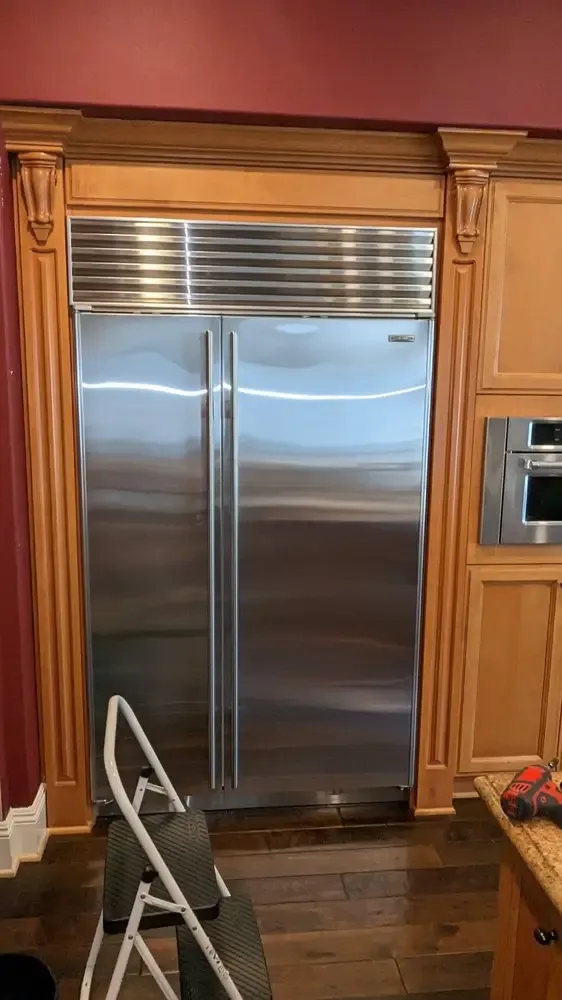
In short: a Classic model number starts with BI- or, on the newest units, CL-. Combination models have separate refrigerator and freezer compressors, so a fault usually stays on one side. A steady Service icon means a minor fault, flashing a major one, flashing with a chime means act now. Do not clear the codes before a technician reads them.
Is it a Classic? Model numbers and the serial tag
Sub-Zero launched this line as the Built-In (BI) series and later renamed it Classic. Doors are stainless or overlay, taking your cabinet panels. A plain model number such as 632 or 650 means the older 600 series.
The model and serial tag is near the top door hinge: in the refrigerator section on an over-and-under, the freezer section on a side-by-side, and the single compartment on a column. Read us both numbers.
| Model letters | Layout | Service notes |
|---|---|---|
| BI-30U, BI-36U | Refrigerator door over a freezer drawer | Two systems. The drawer slides and gasket wear first. |
| BI-36UFD, BI-42UFD | French doors over a freezer drawer | The hinged flipper on the left door must fold and seal. |
| BI-36S, BI-42S, BI-48S | Side-by-side, freezer on the left | Two systems. SD adds a door dispenser, SID an internal one. |
| BI-36R, BI-36F | All-refrigerator or all-freezer column | One system each. A warm column is a problem in that unit alone. |
| G or A after the layout letter (BI-36UG, BI-36RG) | Glass refrigerator door (A is high-altitude glass) | A heater around the glass stops fogging. |
The newest generation keeps the Classic name with CL model numbers, such as CL3650U. Parts differ by generation, so we order by model and serial.
The BI serial eras
Sub-Zero updated the BI design without changing model numbers, so two BI-36U units can need different parts.
| Era | What changes for a repair |
|---|---|
| Units before serial 4100000 | Small fans keep the crisper drawers a little colder. One water valve feeds the ice maker. Fixed-speed compressors. |
| Units after serial 4100000 and before serial 4380000 | Two rounds of updates; French door and internal dispenser models arrive. |
| Units after serial 4380000 | An air diverter replaces the drawer fans on side-by-sides and the refrigerator column. A second water valve, opening only with the fill valve, backs up the shutoff. By this era the glass-door units, the all-freezer, the 42-inch French door and several 42 and 48-inch dispenser models run variable-speed compressors. New display messages appear. |
| SD units after serial 4520000 | A revised door dispenser with its own parts. |
How a Classic keeps cold
Each side of a combination model has its own compressor, evaporator and fan; the condenser fan runs whenever either compressor does. A warm refrigerator beside a cold freezer points at the refrigerator system.
The refrigerator side has no defrost heater. When its compressor stops, the fan keeps moving air over the coil until the frost melts, so a fan running with the compressor quiet is normal. The freezer uses a heater, and the control spaces its defrosts by how long the last one took. Once at temperature, the display shows an average that changes no faster than about a degree a minute. After a power cycle the compressors wait at least three minutes.
What the display is telling you
- OFF, SA with a small b, or two dashes: switched off, Sabbath mode, or a zone disabled. Settings, not failures.
- EE in place of a temperature: that compartment's sensor or its wiring has failed; a backup timer keeps the compressor cycling.
- Ice cube and Service icons flashing: the ice maker valve stayed open too long several times, and the ice maker is locked out until repaired.
- LO C, H2 LO, dO Or (latest era): a locked control panel, a dispenser paused after heavy use, or a French door left open.
More on Classic Series error codes and the Service light. If an alarm chimes while you wait, call and we will tell you how to quiet it without erasing the history.
What fails on a Classic, most common first
Condenser packed with dust and grease
What it usually is: the top condenser pulls kitchen air all day. Blocked fins make both compressors run long and hot, and near the coast the coil and fan corrode.
What you can check: with the breaker off, look at the coil behind the grille, then brush and vacuum it. See the condenser cleaning guide.
What we do: clean it, check the fan, and confirm both systems recover.
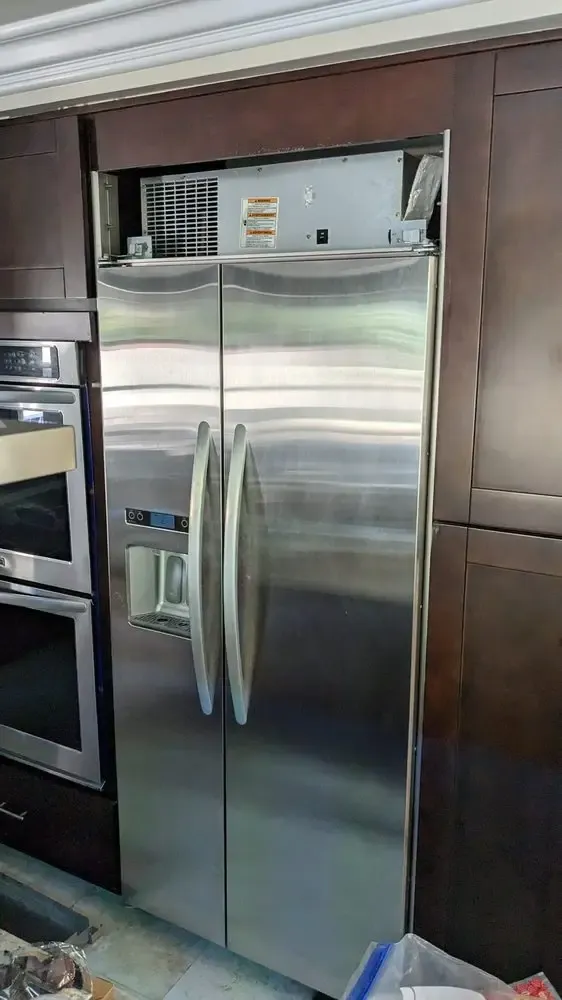
Evaporator and drawer fans
What it usually is: each evaporator fan is a small electronic motor that the control watches. A worn one gets noisy, slows, then stops and leaves a fault in the history. Early units add crisper drawer fans.
What you can check: listen with the door shut. Fans stop when a door opens, which is normal.
What we do: test the motor and the board output, replace what failed and set the blade position. See Sub-Zero making noise.
Freezer defrost
What it usually is: a failed defrost heater or defrost terminator, a board relay that no longer powers the heater, or a blocked drain. Frost chokes the freezer coil and the freezer warms while the refrigerator stays normal.
What you can check: frost on the freezer back wall and ice under the drawer; do not chip at it.
What we do: replace the failed part, clear the drain, thaw the coil and confirm the next defrost. See frost buildup and freezer not freezing.
Ice maker, water valves and the filter
What it usually is: the control measures each fill with a flow meter. Hard water, an old filter or low pressure slow the fill until the control shuts the ice maker off for a day; after five such shutdowns in a row it stays off until the cause is repaired and the fault is cleared. Valves scale and stick.
What you can check: the supply valve fully open, a current filter, the ice maker switched on. With no filter in place, no water flows.
What we do: measure flow, test the valves, flow meter and module, and replace what failed. See ice maker not working and water dispenser not working.
Doors, closers, gaskets and leveling
What it usually is: heavy overlay panels wear the closers and cams, and freezer drawers wear their slides. A door that no longer pulls shut, a flat gasket or an unlevel cabinet brings frost inside and sweating outside.
What you can check: let each door close from halfway open and look for gaps in the gasket.
What we do: replace closers, slides and gaskets, then level and anchor the cabinet. See door not closing.
Sensors, board and control panel
What it usually is: a sensor reading wrong, a board relay that no longer switches, or a panel that lost contact with the board. LO C with the lights out usually means a stuck door switch: the control thinks the door is shut while someone presses the keys, so it locks the panel.
What you can check: the breaker, and what the display shows.
What we do: read the fault history, test sensors, switches and wiring, and replace the failed part.
Sealed system: compressor, leak or restriction
What it usually is: a compressor that no longer pumps, a leak at the evaporator or a joint, or a blockage in the thin tube that meters the refrigerant, usually on one side. On variable-speed models a failed compressor drive can look like a dead compressor.
What you can check: nothing safely. If the condenser is clean and the fans run, call.
What we do: rule out fans, sensors and the drive, then confirm with pressures. Each system holds only a few ounces, so we open it only when needed, and fit a new filter-drier whenever we do. See our job post Sub-Zero Refrigerator Not Cooling? Evaporator Leak Fix (July 2026, Irvine), and the pages on compressor replacement and sealed-system repair.
Repair or replace a Classic
The earliest BI units are now more than fifteen years old, and many are still in daily use. Fans, sensors, valves and defrost parts are routine at any age. A sealed-system repair usually beats replacement on a sound cabinet, because a new built-in must fit the same opening and often needs new panels.
First, Sub-Zero's BI-era warranty covered the sealed system for five years with parts and labor, then parts only to about year twelve after installation. If a compressor or coil fails inside that window, call Sub-Zero with your serial before you approve a repair; the part may be covered even when the labor is not. See the lifespan guide and repair or replace.
What a Classic repair costs
The $79 service call covers the trip and diagnosis and is applied to the repair once you approve the written price. Typical built-in refrigerator repair ranges:
Built-in refrigerator and freezer repair (Sub-Zero, Thermador, Viking, Monogram, Miele)
| Repair | Typical price, parts and labor |
|---|---|
| Condenser cleaning and performance check | $150 to $250 |
| Condenser fan motor | $350 to $600 |
| Evaporator fan motor | $350 to $650 |
| Temperature sensor (thermistor) | $250 to $450 |
| Defrost heater or defrost termination | $350 to $650 |
| Water valve | $300 to $550 |
| Door gasket, per door | $300 to $600 |
| Door hinge or closer cam | $300 to $650 |
| Ice maker assembly | $450 to $900 |
| Electronic control board | $650 to $1,300 |
| Refrigerant leak repair and recharge | $900 to $2,000 |
| Evaporator replacement | $1,200 to $2,500 |
| Compressor replacement (sealed system) | from $2,000 |
Typical Orange County ranges for parts and labor. The $79 service call is applied to any of them. Parts that ship from the manufacturer and older or discontinued models can run higher. You get the exact written price after the diagnosis and before any work starts.
More on the pricing page and in the Sub-Zero repair cost guide. For a 48-inch stainless unit with drawers, see PRO 48 repair; other lines are on Sub-Zero repair, or contact us.
Talk to the technician first
Monday to Saturday, 8 AM to 7 PM. The $79 service call is applied to the repair.
Sub-Zero Classic Series repair: questions
How do I know which BI era my Sub-Zero is?
Read the serial on the tag near the top hinge. Units before serial 4100000 are the original BI; units after serial 4380000 are the latest BI design.
What does the flashing Service icon on my Classic mean?
A major fault has been logged. Note what the display shows, do not clear the codes, and call; the stored history usually points at the failed part.
My Classic shows 3 in the refrigerator and minus 18 in the freezer. Is it freezing everything?
No. Those are normal temperatures in Celsius. We can tell you on the phone how to switch the display back.
Is a 15-year-old BI-36U worth repairing?
Usually, yes. At that age most repairs are fans, sensors, valves or defrost parts.
Do you work on the newer CL Classic models?
Yes, and the BI units before them, from the original design to the units after serial 4380000. We are an independent service, not affiliated with Sub-Zero Group, and order Sub-Zero parts through distributors.